What the heat exchanger actually does
Inside every gas boiler there is a burner producing a flame, and a heat exchanger sitting in the path of that flame. Water from your radiators, or from the cold mains in the case of a combi's hot water, is pushed through the exchanger, and heat crosses from the hot gases into the water through thin metal walls and closely spaced fins. Everything else in the boiler, the pump, the fan, the diverter valve, the controls, exists to keep that transfer happening safely and at the right moment.
Because the transfer relies on thin metal and tight gaps, the exchanger is extremely sensitive to anything that coats it. A layer of soot on the fire side or a layer of sludge on the water side works exactly like loft insulation, except it is insulating the wrong thing: it stops heat reaching your water and traps it where you do not want it.
Dirt on the fire side: soot and combustion debris
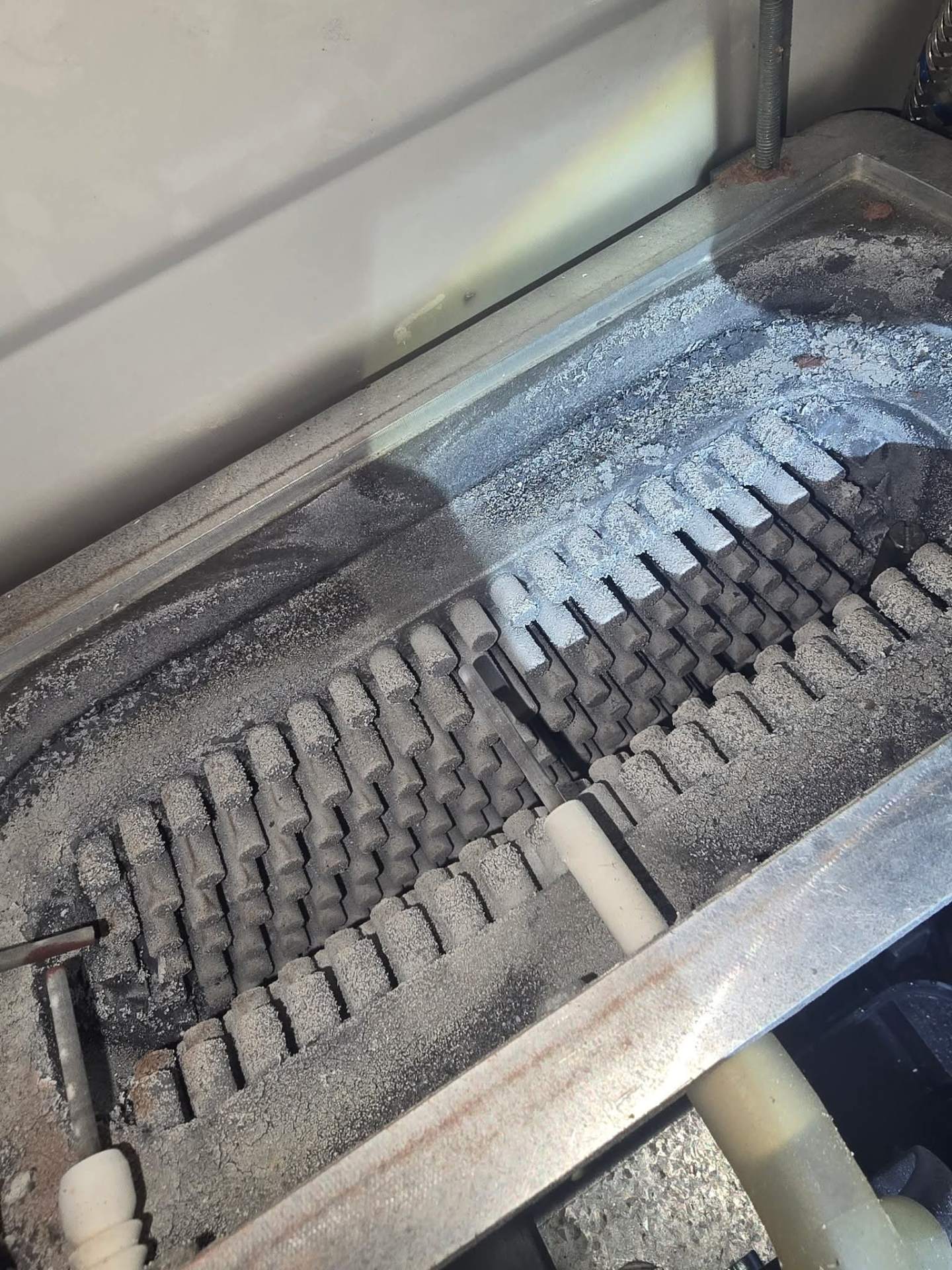
Gas burning perfectly produces carbon dioxide and water vapour, and very little else. Gas burning slightly imperfectly, because the air-to-gas ratio has drifted, because the burner ports are partially blocked, or because the flue is restricted, produces carbon. That carbon lands on the exchanger as soot and slowly bakes on.
In older open-flue appliances, dust, pet hair and building debris get drawn in from the room and add to the layer. In modern room-sealed condensing boilers the flue path is cleaner, but the condensing process itself is mildly acidic, and combustion residue combined with condensate can crust the lower fins and the condensate trap. Either way, once the deposit is thick enough the boiler has to burn longer to deliver the same heat, which produces more soot, which makes it worse. It is a loop that only ever accelerates.
- A burner that has drifted out of tolerance and is running rich
- Restricted or partially blocked flue and air intake paths
- Dust, lint and pet hair drawn into older open-flue appliances
- Condensate trap left unflushed, so acidic residue sits in the boiler
- Years of missed annual services, so nothing was ever caught early
Dirt on the water side: magnetite and sludge
The other half of the problem comes from inside the system. Central heating water sits in contact with steel radiators, copper pipe and brass fittings. Add a little oxygen, from a small leak, an automatic air vent, or repeated topping up, and the steel corrodes. The product of that corrosion is magnetite: a fine, black, magnetic iron oxide that circulates with the water and settles wherever flow slows down.
Radiator bottoms are the classic collection point, which is why a sludged radiator is hot at the top and stone cold at the bottom. But the narrow waterways of a modern heat exchanger are just as vulnerable, and far more expensive. Once magnetite restricts those waterways, water cannot carry heat away from the flame fast enough. The water immediately against the metal flashes to steam and collapses again, and that is the banging, rumbling noise people describe as kettling. Left alone it ends in overheat lockouts and, eventually, a failed exchanger.
This is why inhibitor matters. Corrosion inhibitor in the system water slows the reaction that makes magnetite in the first place, and a magnetic filter catches what does form before it reaches the boiler. Both are cheap. A heat exchanger is not.
The warning signs, in the order they usually appear
- 1Gas bills creeping up without any change in how you heat the house.
- 2Radiators taking noticeably longer to come up to temperature, especially the ones furthest from the boiler.
- 3Radiators cold at the bottom, or black water when you bleed one.
- 4Kettling: banging, rumbling or a kettle-like noise from the boiler when it fires.
- 5The boiler cutting out and locking out on overheat, then resetting fine for a while.
- 6Repeat pump or diverter valve failures caused by circulating grit.
What it actually costs
The first cost is gas. A boiler with a fouled exchanger transfers heat poorly and runs longer for the same room temperature, and 10 to 15 percent extra consumption across a Stockport winter is a realistic figure. That alone is usually more than the price of the annual service that would have prevented it.
The second cost is components. Circulating sludge wears pump bearings, jams thermostatic radiator valves and destroys diverter valves. Each of those is a call-out and a part.
The third cost is the exchanger itself, and it is the one that hurts. It is the most expensive single part in most boilers, and on an older appliance the repair often costs enough to make replacing the whole boiler the more sensible decision. Worse, if the annual services were never carried out, the manufacturer's warranty will not cover it, because almost every warranty is conditional on a logged annual service.
Can a dirty heat exchanger be cleaned?
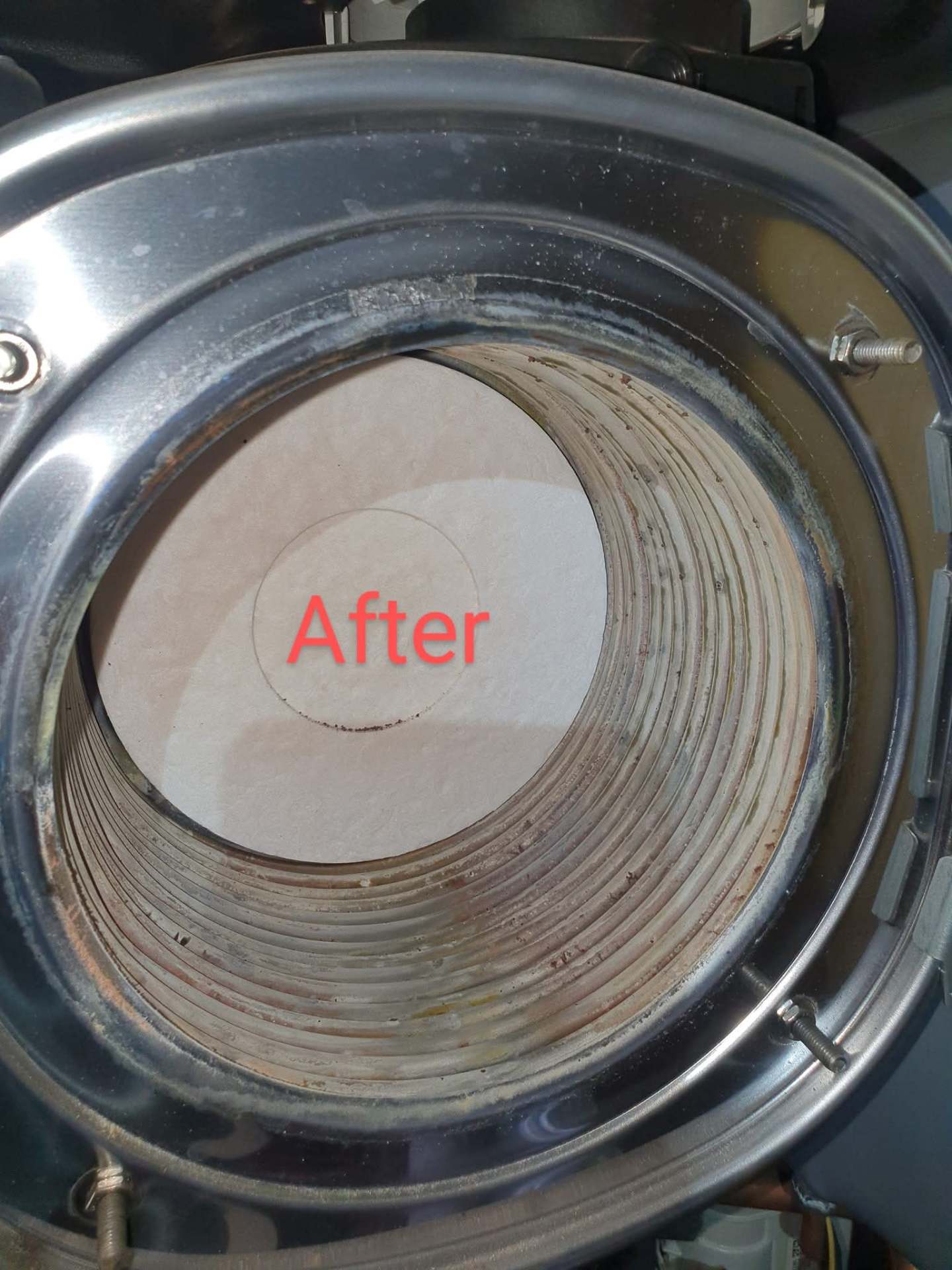
Frequently, yes, and that is the good news. Fire-side soot caught at a normal annual service comes off during the strip-down and clean, and the boiler is then re-commissioned with a flue gas analyser to prove it is burning correctly again. That is the difference between a full service and a fifteen-minute visual check: only one of them touches the exchanger.
Water-side contamination is a system problem rather than a boiler problem, so the fix is a system fix: a powerflush to drive the magnetite out of the radiators and pipework, then inhibitor and a magnetic filter so it does not come straight back. Where an exchanger is already partially blocked it can sometimes be removed and flushed separately as part of that work.
The point at which cleaning stops working is when the deposit has been left long enough to bake on hard, or the exchanger has already corroded through from the acidic residue sitting against it. At that stage it is a replacement, and the decision becomes whether the boiler is worth it.
How to keep it clean, permanently
- Service the boiler every twelve months, with real combustion analysis, not a visual glance.
- Keep corrosion inhibitor in the system water and have the level checked at each service.
- Fit a magnetic filter and have it cleaned out every year.
- Stop repeatedly topping up the system. Frequent pressure loss is a leak to find, not a habit to live with.
- Have the system cleansed whenever a new boiler goes onto old pipework, without exception.
- Deal with kettling or cold radiators when they start, not two winters later.
None of this is complicated, and none of it is expensive relative to what it prevents. It is simply the difference between a boiler that reaches twelve to fifteen years and one that starts failing at seven or eight.
Common questions
What are the signs of a dirty heat exchanger?
Kettling or banging noises, the boiler cutting out on overheat lockout, radiators slow to warm, black water when bleeding, rising gas bills for the same comfort, and a yellow rather than crisp blue flame on older open-flue appliances.
Can a dirty heat exchanger be cleaned?
Often, yes. Combustion-side soot can be cleaned during a full service if it is caught early. Waterside blockage caused by magnetite usually needs the system powerflushing, and in bad cases the exchanger itself has to be removed and flushed or replaced.
How much does a heat exchanger replacement cost?
It is the most expensive single component in most boilers, typically several hundred pounds in parts alone before labour. That is why an annual service and a magnetic filter are such cheap insurance by comparison.
Does a dirty heat exchanger waste gas?
Yes. Soot acts as insulation between the flame and the water, so the burner has to run longer to transfer the same heat. A neglected boiler can easily burn 10 to 15 percent more gas than a clean one.
Is a dirty heat exchanger dangerous?
It can be. Heavy fouling changes how the appliance burns and can affect flue gas clearance, which is a carbon monoxide risk. That is exactly what combustion analysis at an annual service is designed to catch.
How do I stop it happening again?
Annual servicing with proper combustion analysis, corrosion inhibitor in the system water, a magnetic filter fitted and cleaned each year, and no repeated topping up with fresh oxygenated water.